Each month, we profile someone connected to CBRC, featuring them in The Update, our monthly newsletter. Check out the June 2025 newsletter here.
Not subscribed yet? Sign up for The Update here.
Mariam Mannai (they/them) is a member of CBRC’s Coalition Advisory Committee, as part of our Intersectoral Action Fund project to establish a national coalition to end conversion practices in Canada. Originally from Tunisia, they are an Amazigh, Muslim, and non-binary activist, and have been advocating for LGBTQI+ rights across the Southwest Asian and North African (SWANA) region since 2006. They are also a board member of Agir Montreal, an organization dedicated to supporting LGBTQI+ refugees, asylum seekers, and immigrants.
Since relocating to Montreal in 2017, Mariam has co-founded the organizations Without Restriction in Tunis and Mubaadarat in Montreal. “My journey is deeply personal. I came to this work through lived experience and through the community support I've been doing for over a decade.” Mariam shares. “As a trans and non-binary Muslim, and survivor of various forms of coercion, I have witnessed how conversion practices are often disguised as care.” These practices can show up as attempts for spiritual “healing” or pressure from one’s cultural and religious community to conform to heteronormativity. Mariam finds it important to mention that Mubadaraat has been on hiatus because of capacity issues. As a refugee-led organization, many of its members have turned their focus to supporting Palestinian refugees.
“The queer and trans Muslim community in Canada often faces a double bind,” Mariam says. “On one hand, they are navigating Islamophobia from the general public and in mainstream LGBTQI+ spaces. On the other, they are navigating homophobia and transphobia within their cultural or religious communities.” For refugees and immigrants, Mariam says that this can be worsened by isolation. In the case of asylum seekers, there is also a burden to “prove” one’s queer or trans identity to access either protection or support services. While barriers exist, “just existing as queer and trans Muslim survivors of conversion practices is proof of resilience,” Mariam shares. “It is proof that we can survive violence and continue to be who we are.”
Mariam feels hopeful about the possibilities that a coalition for stopping conversion practices can offer. “The coalition brings together survivors, researchers, advocates, and frontline workers to collectively end conversion practices in Canada,” Mariam says. “ What makes the coalition significant is that it centres survivors of conversion practices, especially those most impacted—BIPOC, trans, immigrant, and faith-based communities.” To hear more about Mariam and other survivors’ perspectives, please join us on June 19 at our upcoming webinar, What’s Next in the Fight Against Conversion Practices in Canada? Register here.
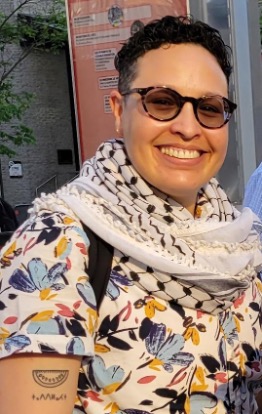
Photo: Mariam Mannai
“It excites me to see survivors becoming leaders in this work. Coming together to create tools rooted in our realities is incredibly powerful.”
