Each month, we profile someone connected to CBRC, featuring them in The Update, our monthly newsletter. Check out the May 2026 newsletter here.
Not subscribed yet? Sign up for The Update here.
Loïs Crémier (they/them) is a semiologist who has always loved theory, political reflection, and the human and social sciences. From an early age, their curiosity pointed them in the direction of graduate studies, and semiology seemed entirely appropriate: “the most ‘head-in-the-clouds’ discipline you can imagine.” To maintain their passion for theory, Loïs found a balance between research, activism, community leadership, and art-based approaches.
Loïs’ doctoral thesis explores the ideas of the “neutral,” the “epicene,” and the “inclusive”, in an effort to understand how the meanings of these concepts have evolved in Quebec over the years, in light of queer, feminist, and trans language practices. French is a gendered language, meaning masculine or feminine gender is always assumed or implied when referring to people, objects, and other nouns. These rules are at the core of the French language, creating challenges for 2S/LGBTQIA+ people. By studying existing interventions in the French-speaking world and the surrounding societal discourse around this subject, Loïs developed expertise on how 2S/LGBTQIA+ people are included in language and social spaces. By theorizing “inclusion” within the framework of so-called inclusive communication, Loïs aimed to show “that there is not just one way to have a more inclusive language—there is no universal response.” One must pay attention to the various forms of expression mobilized by different communities if one is to understand the “inclusivity” put forward in Loïs’s work, a form of listening that echoes the principles of community research. With this perspective in mind, CBRC invited Loïs to provide insight on how inclusive writing is a health issue.
For Loïs, research is an essential component in supporting advocacy for the rights of 2S/LGBTQIA+ people. During their doctoral studies, Loïs took an interest in “projects enabling us to leverage our research capacity in the interests of advocacy and strategic intervention.” They worked with the Conseil québécois LGBT to develop 2S/LGBTQIA+ health resources, such as a guide for architects and urban planners on how to create inclusive spaces in building planning. Loïs also gave a workshop at CBRC’s 2024 Summit titled “Action against Homo/transphobic Disinformation: A Québec Perspective.” They have been giving presentations and workshops on inclusive communication for the last decade, working with organizations such as the Translation Bureau of Canada and the Bureau du coroner du Québec.
Loïs was brought on by the Canada Research Chair on Third-Party Reproduction and Family Ties, to coordinate a production of short videos focusing on harm reduction in relation to online sperm donation. Loïs explains there is a legal gap in Canada: “Online informal sperm donation is perfectly legal. But cases of abuse have been documented; in one case, the parents found out that a donor had made many more donations than he had previously claimed.” These abuses, which mainly affect single-parent and LBQ+ families, raise important ethical, medical, psychosocial, and legal issues that need to be studied in order to respond effectively.
Loïs is currently a postdoctoral fellow at the Canada Research Chair on Third-Party Reproduction and Family Ties, working under the supervision of Isabel Côté and Sabrina Zeghiche to produce a photovoice project with parents affected by the actions of prolific sperm donors in Québec.
In parallel with their research, Loïs nurtures an artistic streak with a political edge. As co-founder of the Béances éditions collective, Loïs puts into practice the connections between translation, creativity, and the political. The “Microédition transbidykes” collective translates and republishes texts from the 1980s and 1990s: These texts, Loïs explains, were “written by trans, dyke, queer, or lesbian authors. They were never translated and have never circulated in French, but deserve to be heard today. There were people 30, 40, or 50 years ago who were saying exactly what we need to hear today.” At Béances éditions, the text is enhanced by its association with art, and books are considered aesthetic objects: “We use our creativity as graphic artists and designers to draw connections between text and meaning. It’s our way of bringing the text to life and making it more accessible.”
In their free time, Loïs enjoys using translation, audiovisual formats, zines, collage, and poetry to connect political and theoretical debates with creativity.
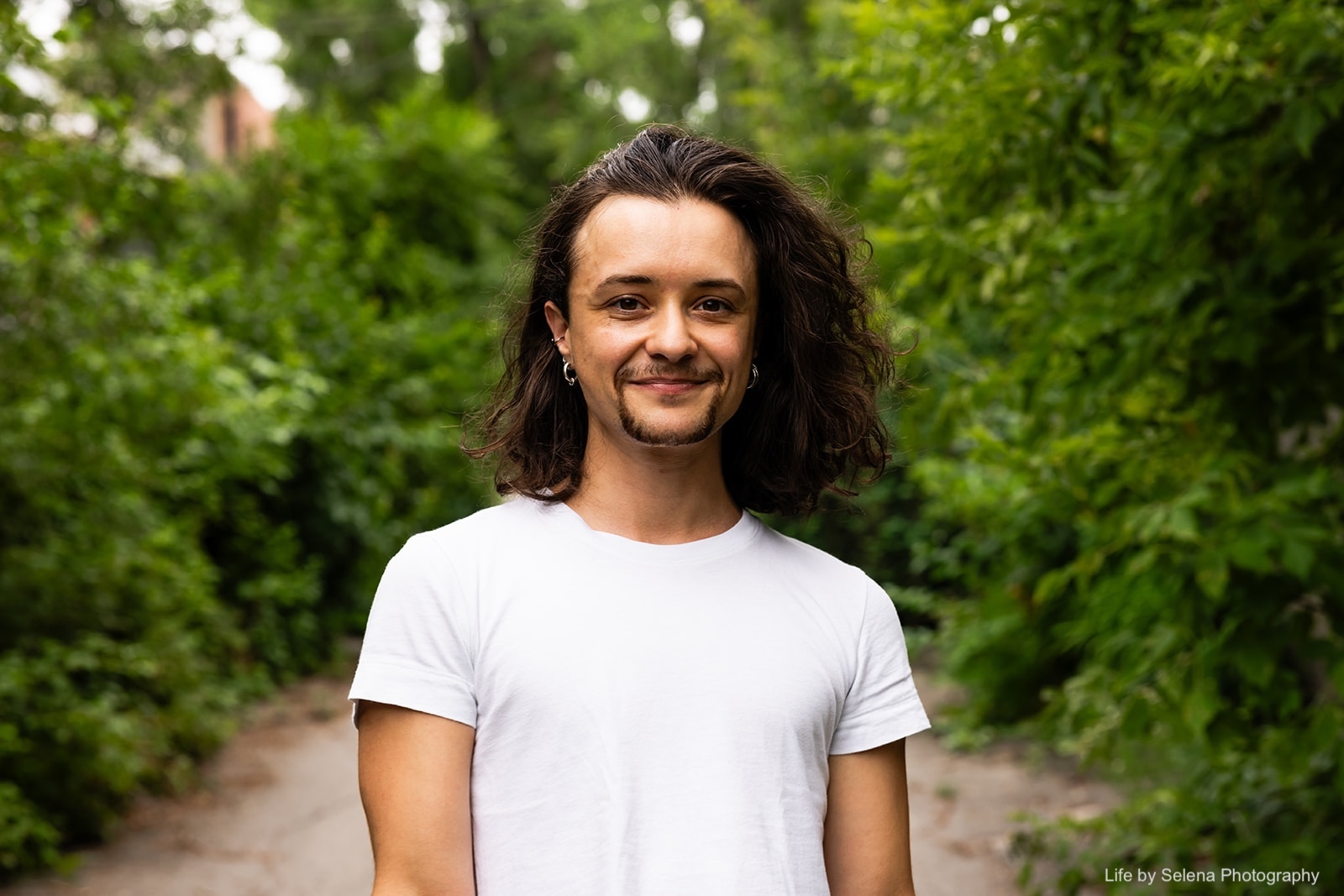
Photo: Loïs Crémier
“Our activism must make room for creativity and pleasure. It’s important to bring living forms of knowledge translation into play—after all, this is also how we show who we are as queer people.”
